September 1, 2023
Philippines vs India: Which Is Better for Australian Businesses Outsourcing?
Both countries are outsourcing giants. But for AU and NZ businesses specifically, one has a clear advantage — and it's not just about cost.

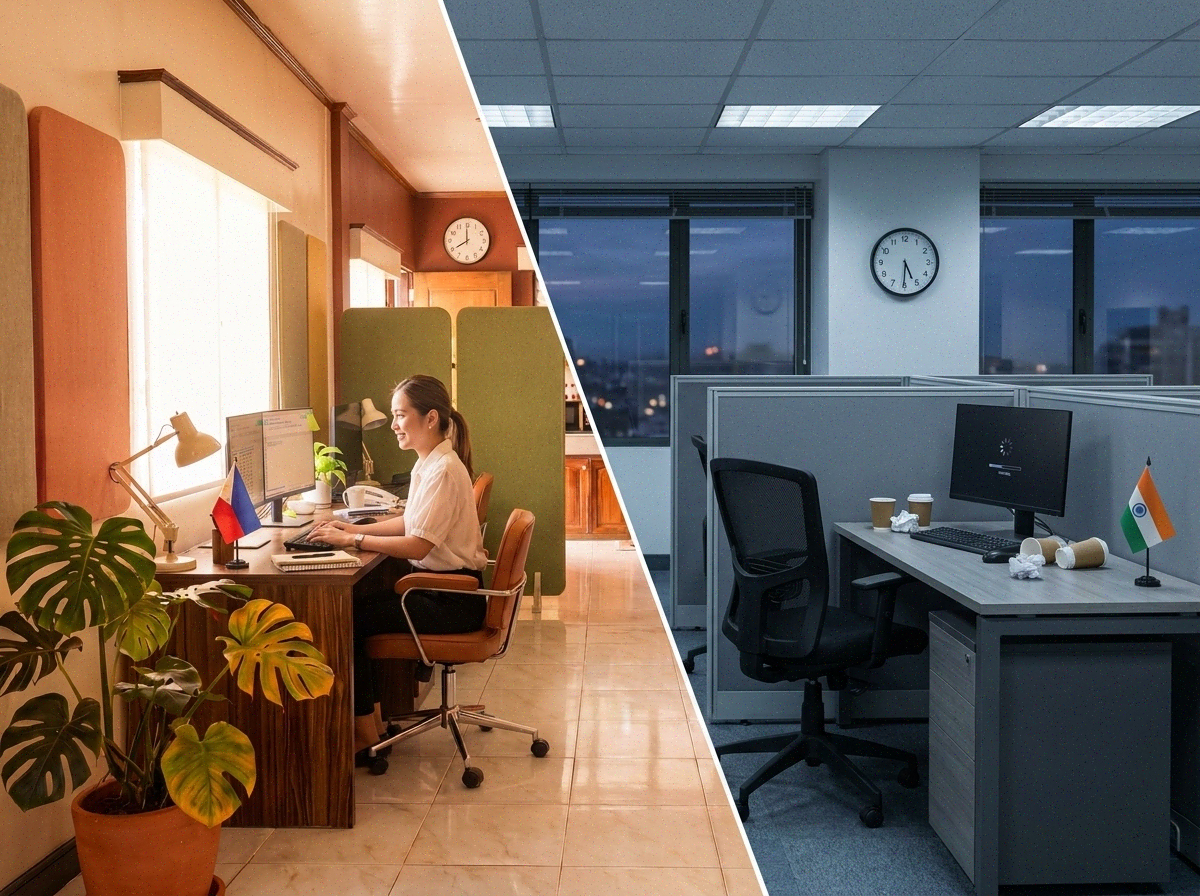
If you're an Australian or New Zealand business considering outsourcing, you've probably narrowed it down to two countries: the Philippines and India. Both have massive outsourcing industries, strong English proficiency, and significantly lower labour costs than Australia.
But for AU and NZ businesses specifically, the differences between the two matter more than most comparison articles suggest.
This is the single biggest differentiator. The Philippines (GMT+8) is only two hours behind AEST. Your team in Manila or Sorsogon starts work at 8am when it's 10am in Sydney. You share an entire working day.
India (GMT+5:30) is four and a half hours behind AEST. When it's 10am in Sydney, it's 5:30am in Mumbai. There's roughly a four-hour overlap in a standard working day — which means a significant chunk of your Indian team's output arrives overnight, and any issues they flag won't get addressed until the next morning.
For businesses that need real-time collaboration — answering phones, responding to customers, attending meetings — the Philippines' timezone advantage is decisive.
The Philippines was an American colony for nearly 50 years, and English is one of its two official languages. Filipino English has a neutral, American-influenced accent that most Australian customers find easy to understand. The communication style tends to be warm, polite, and service-oriented.
India's English proficiency is incredibly high as well, particularly in its major outsourcing hubs, but the accent can be more challenging for Australian callers. This isn't a judgment on quality — it's a practical consideration for customer-facing roles like reception and phone support.
For back-end roles where voice communication isn't a factor — development, data entry, accounting — this difference matters less.
Filipino culture shares some characteristics with Australian culture that make working relationships smoother. There's a strong emphasis on personal relationships, a generally relaxed communication style, and a service-oriented mindset. Filipinos are also heavy consumers of Western media, which creates a shared cultural reference point.
Indian outsourcing culture tends to be more formal and hierarchical. This works well in large-scale enterprise BPO environments but can create friction in small business relationships where the client expects initiative and informal communication.
Costs are broadly similar between the two countries for equivalent roles, though India can be slightly cheaper for highly technical roles like software development. For general admin, customer service, and back-office roles, the cost difference is marginal — and the timezone and communication advantages of the Philippines typically outweigh any small cost savings from India.
India's major outsourcing hubs (Bangalore, Hyderabad, Pune) have world-class infrastructure. The Philippines' infrastructure is generally good in Metro Manila and Cebu but can be less reliable in provincial areas. However, providers who invest in redundant internet, solar power, and generator backup can deliver enterprise-grade uptime from anywhere — including regional locations like Sorsogon, a province with its own geothermal power plant.
For Australian and New Zealand businesses — particularly SMBs that need customer-facing, real-time, relationship-driven support — the Philippines is the stronger choice. The timezone alignment alone makes it worth the decision.
India remains competitive for large-scale technical projects, enterprise IT outsourcing, and roles where timezone overlap matters less.
If you've never outsourced before and want to know what the process actually looks like, check out our guide to your first 30 days.
Based in Sorsogon, Philippines — 2 hours from AEST. See how our timezone works for you →
Our latest news and trending topics


